On March 22, 2026, I rode VIA Rail through Georgetown and Milton to Aldershot on CN’s Halton Subdivision.
(more…)Category: Trains
-
Toronto-New York-Montreal
In May 2023, I rode Amtrak’s Maple Leaf from Toronto via Niagara and Buffalo to New York City. I stayed overnight in New York and then took the Adirondack from New York to Montreal.
(more…) -
Sudbury to White River
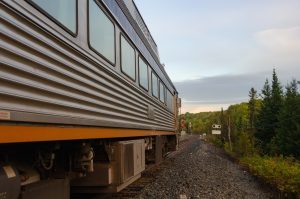
VIA Rail operates its “Scenic Adventure Route” from Sudbury to White River. This train uniquely uses two or three “Budd” cars on an 8-hour schedule through northern Ontario.
I rode this route there-and-back over a weekend in September 2022. On Saturday morning, I persuaded my hotel to allow me to leave my car for a couple of days and walked to the Sudbury train station to start my journey.
The ticket requires passengers to be ready to board 30 minutes early to provide flexibility on departure time but we left almost exactly on time at 9am. The two-car train consisted of #6219 for passengers and #6250 for baggage. On busy days, they add a second passenger car. Only there only two us going all the way to White River with the remainign passengers going to camps accessible only by train.


After about 45 minutes we stopped in Cartier. The crew loaded the baggage car with some ATVs, canoes and camping equipment for passengers disembarking at camps along the way.

Canoe trip supplies being loaded 
Loading an ATV 
Cartier Station Other than Sudbury, Cartier, Chapleau and White River, all the stops are flag stops and the train will only stop upon request. The train will also stop anywhere, such as dropping off canoeists along the Spanish River or hunters near their camps.

Inside of the baggage car 
Unloading camp supplies For most of the trip, the view was of small lakes and ponds as the train followed the meandering CPKC mainline.


The passengers were on their own for food and refreshments. I had packed sandwiches and snacks from Sudbury for my lunch. The car attendant had a short menu of coffee, tea, water and chips and chocolate bars. There is no cell coverage for basically the entire trip. I brought a radio scanner to listen to the conversations with CPKC dispatch and the hotbox detectors. The train uses the Canadian Pacific mainline so is often asked to pull onto sidings (at one point a stub-end siding) to allow eastbound freight trains to pass. Most of the passes where tightly dispatched and we just had to slow down but sometimes we waited almost an hour in the siding.
Unfortunately, passengers cannot see out the front of the train because that area is reserved for the staff. However, the crew were very friendly and allowed us to hop off at many of the flag stops to stretch our legs and told stories of the train.


White River

In White River, we offloaded and the train motored off to its train shed. I was reminded to arrive early the following morning for the return trip. The sleepy town lay between the tracks, which obviously used to be the main focus, and the Trans-Canada Highway. Most of the activity these days was along the highway.
I had reserved a room at the White River Motel but I believe the train crew stayed across the street at the Continental Motel. In addition to having dinner, I picked up more sandwiches and snacks for the return journey since I didn’t know what might be open in the morning before 6:30am when I was expected back at the station.
The town’s claim to fame is being the origin of Winnie the Pooh (wikipedia)

White River 
White River Station 
Winnie-the-Pooh at the side of the Trans-Canada 
“Where It All Began” Return Trip
We left White River in the dark and in heavy fog but it quickly turned into a sunny day.


We once again had stops to pick up and drop off passengers and equipment. At some stops, people had ordered goods to be dropped off unattended. The crew unloaded to the side of the tracks and presumably the person who had ordered it would pick it up later in the day.

One point of interest was the former crossing of the Algoma Central Railway at Franz. As seen below, the rails had been pulled on the level crossing and trains on the ACR could no longer cross the CPKC.

More views of the lakes, cottages and trees:


Stopping in Chapleau for refueling The Sudbury downtown train station was next to the CPKC rail yard:

The Canadian
The transcontinental train, The Canadian, passes through “Sudbury Junction” about 10km from the train station where the White River train departs.
On the Friday night before catching the train, I was able to watch The Canadian roll south many hours late on its trip from Vancouver.

I was also able to catch the same train heading back to Vancouver on Sunday afternoon as I drove back to Toronto. This is just south of Sudbury.

-
Trans-Siberian
In August 2006, I travelled around the world in 28 days via St. Petersburg, Moscow, Siberia, Mongolia, China and Vancouver.

Trans-Siberian at speed The ‘Russia and Beyond’ part of the trip was with a group tour organized by Intrepid Travel. This was a group of 12 people from all over the world and one tour leader who showed us the sights and kept us out of trouble. It was a fantastic way to see that part of the world.
I met the other members of the group in St. Petersburg where we toured the city for a few days before taking a train to Moscow. After a day in Moscow, we hopped on a Trans-Siberian train for the 4 day trip to Irkutsk in Siberia. We had a refreshing swim in Lake Baikal, the largest lake in the world by volume, then took the 2 day train to Ulaanbaatar, the capital of Mongolia.

Mongolian plains The highlight of the trip was the 2 days we spent in a ‘ger’ camp in rural Mongolia. From Mongolia, we caught the 1.5 day train to Beijing for a few days of big city life.
From Beijing, I flew to Vancouver for some time visiting with my family. My girlfriend joined me there for a tour of part of British Columbia. I completed my circuit of the world by flying the relatively short distance from Vancouver back to Toronto.
Overall, I travelled about 8500 km by train, over 25% of the total trip distance.
St. Petersburg and Moscow

Leaving Toronto Immediately after landing in St. Petersburg (via Frankfurt), I got my first taste of the adventure that was to follow as I navigated the St. Petersburg bus and metro system with no language and minimal ability to decipher the Cyrillic alphabet. Fortunately, I was able to follow the instructions from Intrepid and arrived at the starting hotel with an hour to spare before the 6 o’clock group meeting.
After introductions, we went to a local restaurant for dinner. For evening entertainment, some of us went for drinks and a midnight cruise on some of St. Petersburg’s canals and to watch the opening of the many bridges across St. Petersburg’s main river, the Neva River. We staggered back to the hotel very late.

Lifting bridges on the Neva River 
Hydrofoil The next day, I spent a large part of the day touring the Hermitage Museum, one of the largest art galleries in the world. In addition to the Picasso’s, Da Vinci’s and famous European art, I was struck by the incredible building, the Russian Tsar’s Winter Palace that now houses the museum.

Inlaid wooden floors 

Statues 

Wooden door 

Winter Palace After the museum, I wandered through some of the streets of St. Petersburg, then north across the Neva River to the Peter and Paul Fortress which was formerly a prison for political prisoners under the Tsars. It is now a tourist area and museum. I had an afternoon nap and then some of us from the group met for dinner.

Nevsky Prospect 
Russian bear 
Fortress Warnings 
Palace Square The next morning we checked out of our hotel rooms but left our luggage in storage as our train did not leave until midnight. I walked to the Church on Spilt Blood and toured the incredible mosaics – hard to believe how much work it took to place the millions of tiny ceramic tiles to create the images.

Interior mosaics 
Exterior with ornate domes I then toured the St. Petersburg railway museum that contained huge intricate models of bridges, steam engines, signal systems and other railway hardware. Unfortunately the museum charged five times as much for photography permission than for the basic entrance fee so no photos by me. I also checked out St. Isaac’s Cathedral, one of the largest domes in the world.

St. Isaac’s Cathedral 


Late in the evening, we all met at the hotel for the short taxi ride to the train station where we waited for our midnight departure. I slept for the entire trip into Moscow where we arrived at 8am.

St. Petersburg train station 
Arriving in Moscow In Moscow, we checked in at the hotel and then headed downtown by metro to visit the Kremlin – the fortified centre of the Russian government but for tourists consists primarily of churches. The group split up as people’s interest in old churches differed. I wandered through Red Square, GUM – a huge shopping centre, and did some souvenir shopping. The group convened for dinner just outside Red Square which was memorable for the very enthusiastic waiter.

Guards outside the Kremlin 

Tsar’s Cannon 
Moscow wish 

Buying matryoshka 
St. Basil’s Cathedral 
ΓΥM 
Old and new in Moscow 
Gold dome and Moscow River 
Our 2000 room hotel The next morning we hit the supermarket for noodles and crackers for our 4-day Trans-Siberian train trip. With our bags and food, we boarded the train for the start of the journey to Siberia, Mongolia and China!

Boarding the Trans-Siberian in Moscow Crossing Russia to Siberia
We boarded the train just after noon on August 8th. At 11am on August 12th we disembarked in Irkutsk, Siberia – 5185 kilometres and 5 timezones later. The experience of travelling for this length of time on a train is hard to describe but felt like an endless picnic. We watched the trees, towns, villages and more trees pass by the window, slept, ate, napped, chatted, read, laughed, took photos, played games, ate, visited, and laughed some more.
The train ran almost continuously for the entire period with the math working out to an average speed of 80 km/h. Every 4-6 hours were short stops usually 5 to 20 minutes – just enough to get off and stretch the legs but never time to venture beyond the station platform. The train arrived in Irkutsk right on schedule.
Food and Drink
No food seemed to be available on the train, so we ate what we had bought in Moscow and purchased from babushka and shops on the platforms. There was a restaurant car on the train but they never seemed to have food available. Vodka and beer were eagerly sold by the restaurant proprietor and we met some interesting people there, including Nick’s Mongolian train driver friend.

Is it sparkling water? 
Instant noodles 
Drinks in the restaurant car Since the train never stopped for more than about 25 minutes and could leave at any moment, we never ventured off the platforms. Fortunately, at most stops there were people selling stuff or small shops to buy essentials.
Our purchases ranged from delicious raspberries to not so delicious fish pancakes. Water, beer, juice, bread and ice cream were also usually available.


Visiting and Reading
65 hours on a train leaves lots of time for talking, reading, napping and visiting. We were all amazed at how quickly the time passed.


The Carriage
The attendants in our car guarded the steps at stops, cleaned the car and toilets and rarely smiled. Our lives were governed by the schedule posted in the corridor which set out the scheduled arrival and durations of all the stops. The toilets were locked 20 minutes before and after stations. The entire train and all the stations ran on Moscow time – even when local time was 5 hours ahead.

Schedule 
Carpet Cleaning The twelve of us were split between 3 four-person compartments adjacent to one another on car 16 of the train. Julie, our tour leader, was next door sharing a compartment with 3 others. Sharon, Janiece, Sinead and I shared our compartment.


Scenery
We passed huge cities and small villages. The villages we blasted through without slowing down. The large cities included Novosibirsk, Russia’s third largest city.


Russian village; sleepy station; urban development; endless rural roads But much of the time we passed through endless countryside. The endless forests of Russia faded into the rolling hills of the Ural Mountains which eased into the more open flats of Siberia over the course of the trip.


Siberia
The provodnitsa woke us at 4am for our 6am stop in Irkutsk, Siberia. We suffered some ‘jet’ lag as the local time was 11am and almost lunch time even though we were just waking up. After arriving in Irkutsk on the Trans-Siberian, we spent 2 days at Lake Baikal and Irkutsk before boarding the train to Mongolia.

Unloading in Irkutsk At the busy Irkutsk train station we left our train and boarded a minibus for the 1 hour trip to the town of Listvyanka on Lake Baikal. Lake Baikal is the largest lake in the world by volume and contains 22% of the world’s fresh water.


“Shop (rounot the clock)”; Sufferers of Trans-Siberian ‘Jet lag’ At Lake Baikal we were divided up into groups of 2 and 3 for several guesthouses. It was nice to get a shower after 4 days on the train. After tea, we reconvened for a walk into Listvyanka about 2km away for a late lunch.


Walking into Listvyanka; Gathering water; Lake Baikal Then we explored the wooden buildings of the town and then came back to the lake for a wonderful sauna next to the lake.


Wooden homes; Sauna; Pre-sauna swim in the lake; Colours over Lake Baikal I slept through an excursion up to a local hotel for drinks in the evening. The next morning after a fabulous breakfast at our guesthouse, we met up for a walk to the top of nearby hill for a view over the lake. The weather was poor which limited our view.


3-course breakfast; Walking in the rain; View over Lake Baikal Back in Irkutsk, we toured a ‘Decembrist’ house used by instigators of a 1825 uprising sent to Siberia by Czar Nicholas I. After the tour, we caught up on email and stocked up on food for the next part of our journey.


Decembrist house; Horses and camels; Irkutsk street; Cathedral of the Epiphany Back at the Irkutsk train station in the evening, we caught our Trans-Mongolian train for Ulaanbaatar. The train contained a mix of Russian and Mongolian carriages. Our route followed the Trans-Siberian for about 460km to Ulan Ude before heading south to the Mongolian border.

At the train station for the Trans-Mongolian train The Trans-Mongolian
We caught the train in the early evening which meant we passed the spectacular shore of Lake Baikal in darkness. When we awoke the next morning (some earlier than others), we were already heading south toward Mongolia, having left the Trans-Siberian trackage in Ulan Ude during the night.


The plains of southern Siberia; Passing Goose Lake In Naushki, the Russian border town, we had a couple of hours to spend the last of rubles on the platform before the authorities locked down the train to begin the border procedure. After a further 3 hours of waiting we were released for the 20km trip across no-man’s-land to the Mongolian border. There are few photos as people were nervous about photography during the border crossing.


Boredom sets in; Crossing no-man’s-land We immediately noticed the difference between the cold Russian authorities and the Mongolians. The Mongolians took their job seriously but I think realized we were real people. The Mongolian border guards even waved as we left the border!


Watching Mongolia; A Mongolian family waves to the train As the sun set on our first day in Mongolia, we had a short station stop seemingly timed so we could enjoy the sunset.


Dawn found the train descending into Ulaanbaatar, the capital of Mongolia. We arrived at 7am and were taken by bus to change money and shower at a hotel before being taken to a ger camp outside the city.

Descending into Ulaanbaatar 

Ulaanbaatar Station Mongolian Ger Camp
After exchanging our US Dollars for Mongolian Tugrug and having a refreshing shower, we went by minivan out of the city. We travelled alongside another Intrepid tour. Our first stop was a ger, or yurt, where we sampled some Airag, Mongolian fermented mares milk and got a tour of the ger.

Making Airag 
Tour of a gerAbout 70km from Ulaanbaatar, we entered Terelj National Park and arrived at our ger camp. We were surrounded by grasslands, rocky outcrops and grazing livestock. There were many ger camps scattered around catering to the tourists.

View out the door 
Tea in the ger 
After a break for a delicious lunch provided by the ger camp, some horses were located and we went on a 2-hour horseback ride into the next valley. My horse was considered too wild for my limited horse riding skills so a small boy led my horse.


Horseback riding; My guide and his horses After our ride several of us climbed up to the ridge behind our camp for fabulous views of the surrounding valleys and toward the plains in the distance. The next morning, I again climbed the ridge as the sun rose. I was fortunate to find a herd of horses grazing next to a single ger in front of the dramatic views of the rolling hills.


Horses grazing 


After breakfast, some of us walked for several hours to a nearby temple built up on the side of a hill. We enjoyed the views over the gers and grasslands.


After our walk, we took the bus back to Ulaanbaatar for the afternoon and evening. Afternoon activities included Internet, grocery shopping, monastery touring, and souvenir shopping. We also went to a cultural show that included unique throat singing and traditional Mongolian music. After dinner we checked out the Chinggis brew pub and even (momentarily) a Mongolian night club.


Sühbaatar square Early the next morning, we were back at the Ulaanbaatar station to catch our train south to China.

China
Having left Ulaanbaatar in the morning, we spent a day and a half on the train heading southeast to Beijing. The first day was spent crossing some low mountains and then the Gobi Desert.


Crossing the Gobi Desert The border crossing between Mongolia and China took several hours but was broken up by the changing of the wheels. Russia and Mongolia use 5ft broad gauge track, while China uses 4’8.5″ standard gauge. Rather than moving passengers between carriages, the Chinese lift the carriages (and passengers) in the air and replace the wheels.


Dining car; Changing the bogies When we woke up the next morning in China, the train was climbing up to cross the mountains about 100km from Beijing. We crossed under the Great Wall in a 2km tunnel and then began the descent into Beijing.

Train and Great Wall 
Descending through the mountains 
Washing the windows after the desert 
Arrival in Beijing Beijing and the Great Wall
After freshening up at our hotel, we went for a walking tour of central Beijing, including the Tiananmen Square and some shopping streets and finishing with a delicious dinner.


Night Market 


Tiananmen Square The next morning we got up early for a 70km bus ride to the Great Wall at a spot called Mutianyu. We climbed up to the Wall on a ridge and spent a couple of hours wandering between the towers. The Great Wall is an unbelievable structure – it stretches about 6000km and along our stretch was about 7 metres high and 4 metres wide.


To get down, we had an exciting ride down a toboggan ride (twice!).


After busing back to Beijing, I headed off by myself for a walk through of the Forbidden City. I admired the ornate and colourful wooden buildings.


Departure
After a dinner of Peking Duck, we settled into a roof top lounge for cocktails and visiting for our last evening as a group. We had a beautiful view out over the city with construction cranes swinging over our heads as we enjoyed the evening. It was hard to believe that our journey together was over already.


The next morning, I shared a cab with George and Ann to the airport for my flight to Vancouver via San Francisco. Because of the timezones and date line, I arrived in Vancouver before I left Beijing. My whole family was there to meet me at the airport.


More instant noodles on the plane ride; arriving in Vancouver -
Toronto to Halifax
In August 2005, I took some time away from my summer course work and did a quick trip by train to Halifax and back. It was my first time sleeping overnight on a train. It was lots of fun and I met some great people on the way.
I left Toronto in the evening and travelled overnight in coach class to Montreal (this train was cancelled soon afterwards). I then spent the day touring Montreal before catching the train to Halifax.


In the early evening I caught The Ocean east on the 24 hour trip to Halifax. After a three course dinner in the dining car as we headed along the Saint Lawrence River, I settled into the dome car to watch the stars and sample the wine.
I slept in an upper berth but got up early for the sunrise. The whole next day was spent eating in the dining car and sitting in the dome. The carriage attendant offered commentary and pointed out sights as we passed through the villages and towns. We arrived in Halifax in the late afternoon.


In Halifax, I discovered that the Halifax Busker Festival was taking place on the waterfront. I spent the night in a hostel. The next morning I walked through the Halifax citadel before catching my noon train to take me home.


Then it was another 24 hours on the train back to Montreal with an early morning arrival. Then a quick train switch for the ride into Toronto in the afternoon.


